

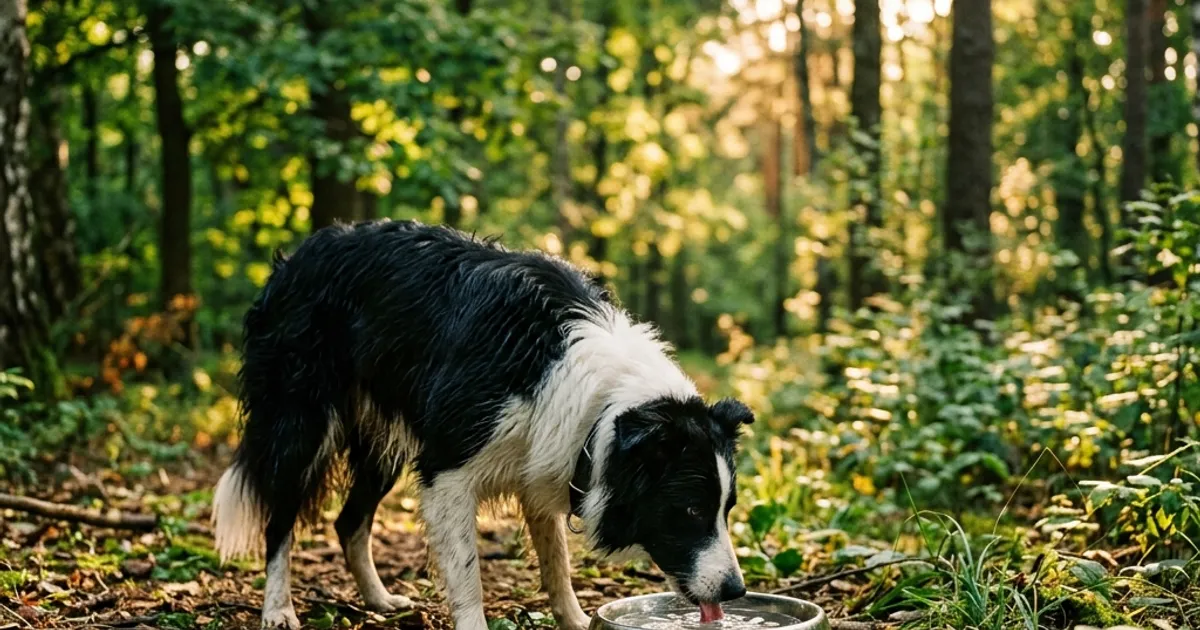
Heatstroke in Border Collies: Science-Based Prevention and Risk Management
Dogs Die on Walks, Not Just in Cars
When summer arrives, warnings about leaving dogs in hot cars dominate the conversation. The advice is valid, but the statistics tell a more inconvenient story.
A landmark study published by the Royal Veterinary College (RVC) VetCompass Programme revealed that 74.2% of canine heat-related illness (HRI) events were caused by exertion or exercise—compared to just 5.2% attributed to vehicular confinement. More strikingly, 68% of those exercise-related cases occurred during ordinary walks, not strenuous activity (Dogs Don’t Die Just in Hot Cars, Animals, 2020).
The implication is clear: the most common threat to dogs in summer is not a parked car. It is routine outdoor activity in warm conditions. Shifting focus from car safety to exercise and time-of-day management is the more statistically defensible intervention.

How Dogs Regulate Body Temperature
A dog’s normal resting temperature is 38–39.5°C (100.4–103.1°F). The thermoregulatory center in the anterior hypothalamus monitors core temperature and activates cooling responses when overheating is detected.
Unlike humans, dogs do not sweat across their skin surface. Their primary cooling mechanism is panting—evaporative cooling through the moist surfaces of the mouth and upper respiratory tract. Minor sweating through the paw pad sweat glands provides a supplementary but limited contribution.
This system is highly sensitive to humidity. In humid conditions, moisture in exhaled air cannot evaporate efficiently, dramatically reducing panting’s cooling power. Japan’s hot-humid summer climate is particularly challenging for dogs for exactly this reason.
A core body temperature exceeding 41°C (105.8°F) meets the clinical definition of heatstroke (Pathophysiology of Heatstroke in Dogs, Temperature, 2018). At this threshold, multiple organ systems are at risk simultaneously. One of the most dangerous mechanisms is intestinal barrier breakdown, which allows gut bacteria to enter the bloodstream and trigger systemic inflammatory response syndrome (SIRS).
Signs of Heat-Related Illness
Early Signs (core temperature 39.5–41°C / 103–105.8°F)
- Rapid, heavy panting
- Elevated heart rate and respiratory rate
- Restlessness, inability to settle
- Excessive drooling
- Bright red gums and oral mucosa
Moderate Signs (core temperature above 41°C / 105.8°F)
- Stumbling, weakness, inability to stand
- Vomiting and/or diarrhea (possibly bloody)
- Altered mentation, poor responsiveness
- Pale or white gums
Severe Signs (core temperature above 41.5°C / 106.7°F)
- Loss of consciousness, seizures
- Cyanosis (blue-purple mucous membranes)
- Bleeding from mouth, nose, or rectum (indicator of coagulopathy)
- Multi-organ failure
The UK-based epidemiological study reported a case fatality rate of 14.18% (95% CI: 11.08–17.96%) among affected dogs (Scientific Reports, 2020). Early recognition and prompt intervention are the primary determinants of survival.
Double Coats and the Shaving Myth
Border Collies carry a double coat: a coarse outer layer (guard hairs) and a dense, soft undercoat. The common belief that shaving this coat in summer provides relief is not only incorrect—it may cause harm.
In spring and early summer, Border Collies naturally shed a significant portion of their undercoat (seasonal coat blow). The resulting thin undercoat functions as a dead-air insulation layer, preventing direct transfer of ambient heat to the skin. In its natural state, the coat operates as a seasonal thermal buffer.
Shaving disrupts this structure. When both layers regrow simultaneously rather than in their natural sequence, the coat loses its original texture and thermal geometry. Guard hairs, which normally reflect radiant heat, can grow back with altered characteristics that absorb more solar radiation. The disruption of layered airflow may further compromise skin-level cooling.
The case for brushing rather than shaving follows from the same principle: regular deshedding removes dead undercoat and restores airflow without disrupting the coat’s functional architecture. Shaving removes the entire system rather than optimizing it.
A Border Collie–Specific Concern: BCC vs. Heatstroke
Border Collie owners should be familiar with a condition that can resemble heatstroke but has a distinct cause: Border Collie Collapse (BCC).
BCC is an episodic neurological disorder triggered by intense exercise, typically manifesting within 5 to 15 minutes of strenuous activity. Signs include incoordination, stumbling, altered consciousness—a presentation that overlaps substantially with exercise-induced heatstroke.
The key diagnostic differentiator is core body temperature over time. Dogs experiencing BCC reach high temperatures (often >41.7°C / 107.1°F) consistent with exercise exertion, but temperature normalizes rapidly once exercise is stopped. In genuine heatstroke, elevated temperature persists without active cooling.
BCC is genetically complex, with a heritability estimate (h2SNP) of 49–61%, indicating a moderately to highly heritable polygenic trait (Heritability and Genomic Architecture of Episodic Exercise-Induced Collapse in Border Collies, Genes, 2021). Critically, BCC is not caused by the DNM1 gene mutation responsible for exercise-induced collapse (EIC) in Labrador Retrievers—it is a separate, as-yet-unresolved condition.
If a Border Collie collapses after exercise, taking an immediate rectal temperature is the first diagnostic step to distinguish BCC from thermal emergency.
Understanding the Danger Zone: Temperature, Humidity, and Pavement
Safe Walking Guidelines
Temperature alone is insufficient for risk assessment. The combination of temperature and humidity—reflected in indices like WBGT (Wet Bulb Globe Temperature) or Heat Index—provides a more accurate picture. As a practical guide:
- Below 25°C (77°F): Generally safe, assuming moderate humidity
- 25–30°C (77–86°F): Exercise caution; limit walks to early morning or late evening
- Above 30°C (86°F): High risk; restrict outdoor activity to pre-sunrise or night
- Above 30°C + humidity above 70%: Extreme risk; consider skipping outdoor walks entirely
In Japanese summer conditions, outdoor activity between approximately 10:00 AM and 4:00 PM is best avoided on hot days.
Pavement Temperature: An Underestimated Risk
Asphalt surface temperatures in summer can reach 50–65°C (122–149°F)—far exceeding ambient air temperature. Contact with surfaces above 55°C (131°F) can cause paw pad burns within 60 seconds of exposure.
A simple field test: if a person cannot hold their bare hand or stand barefoot on the pavement for 5–10 seconds, it is too hot for a dog to walk on. Dogs also walk closer to the ground than humans, where radiant heat accumulates more intensely—meaning a dog’s experienced temperature may be several degrees higher than what a person standing upright perceives.
Grass and shaded surfaces are substantially cooler and preferable when available.
Evidence-Based Prevention
Before and During Activity
- Shift walks to early morning (within 1–2 hours of sunrise) and nighttime hours
- Provide shade breaks every 10–15 minutes during outdoor activity
- Carry fresh water and encourage frequent drinking
- Wet the neck and armpits (areas overlying major blood vessels) for proactive cooling
- Allow heat acclimatization before increasing activity in hot weather. Full acclimatization can take up to 60 days; partial acclimatization occurs within 10–20 days (Cornell University College of Veterinary Medicine)
Environmental Management
- Maintain indoor temperature at 25–28°C (77–82°F) and humidity between 45–65%
- Ensure constant access to fresh water
- Ensure adequate ventilation; fans and air conditioning are effective tools
First Aid for Suspected Heatstroke
The RVC guideline is clear: “Cool first, transport second.” Delaying cooling to transport a dog to a veterinary clinic first can be fatal.
Correct Cooling Protocol
- Move to a cool environment immediately (shade, air-conditioned space)
- Apply cool (not ice-cold) water to the entire body
- Create airflow across the wet body using a fan, air conditioning vent, or natural breeze. Water + air movement (evaporative cooling) is the most effective field method (Penning, V.A., et al., Animals, 2023)
- Focus on the neck, armpits, and groin (areas with major vessels running close to the surface)
- If conscious, offer small amounts of water to drink (avoid large quantities that may induce vomiting)
- Stop active cooling once rectal temperature reaches 39.5°C (103.1°F) to prevent overcooling
- Contact and transport to a veterinary clinic as soon as cooling is initiated
What Not to Do
- Do not use ice or ice-cold water: vasoconstriction at the skin surface can trap heat internally
- Do not wrap in a wet towel: trapping moisture against the skin impairs evaporative cooling
- Do not give water to an unconscious dog (aspiration risk)
- Do not assume the dog has “recovered” after initial improvement; internal organ damage may manifest hours later. Veterinary evaluation is always required.
The Owner’s Role in Canine Summer Safety
The majority of heatstroke cases are preventable through management decisions made before a dog steps outside. The data consistently points to one central variable: when and how much a dog exercises in hot conditions.
Border Collies are high-energy dogs that may continue to push through heat long after it is safe to do so. Their motivation to work and exercise does not signal physiological readiness to perform in high-heat environments. This creates a specific responsibility for the people managing their activity.
Understanding the science changes the response. A dog panting in the shade is deploying its primary cooling mechanism. Interrupted panting, sudden lethargy, or coordination problems are not small concerns to wait out. They are the body approaching its thermal limit.
The goal is simple: keep the dog out of the danger zone, and know exactly what to do if they enter it.
About ROSCH KENNEL: A specialist Border Collie breeder located within Kirishima Kinkowan National Park in Kagoshima Prefecture, Japan, at an elevation of 750 m (2,460 ft). Summer temperatures at the facility remain below 30°C (86°F). All breeding dogs undergo genetic testing for 15+ conditions, with all results publicly disclosed.
References
-
Bruchim, Y., et al. “Pathophysiology of heatstroke in dogs – revisited.” Temperature, 5(2), 2018. PMC5800390
-
Hall, E.J., et al. “Incidence and risk factors for heat-related illness (heatstroke) in UK dogs under primary veterinary care in 2016.” Scientific Reports, 2020. PMC7303136
-
Hall, E.J., et al. “Dogs Don’t Die Just in Hot Cars—Exertional Heat-Related Illness (Heatstroke) Is a Greater Threat to UK Dogs.” Animals, 10(8), 2020. PMC7459873
-
Penning, V.A., et al. “Cooling Methods Used to Manage Heat-Related Illness in Dogs Presented to Primary Care Veterinary Practices during 2016–2018 in the UK.” Animals, 2023. PMC10385239
-
Norton, E.M., et al. “Heritability and Genomic Architecture of Episodic Exercise-Induced Collapse in Border Collies.” Genes, 13(1), 2021. PMC8701027
-
University of Minnesota, College of Veterinary Medicine. “Border Collie Collapse.” https://vetmed.umn.edu/
-
Cornell University College of Veterinary Medicine. “Heatstroke: A Medical Emergency.” https://www.vet.cornell.edu/
-
Royal Veterinary College. “Cool first, transport second.” VetCompass. https://www.rvc.ac.uk/
Daily observation is where the next article begins.
Instagram shows the dogs in daily life. The journal turns the themes we notice there into evidence-aware resources.