

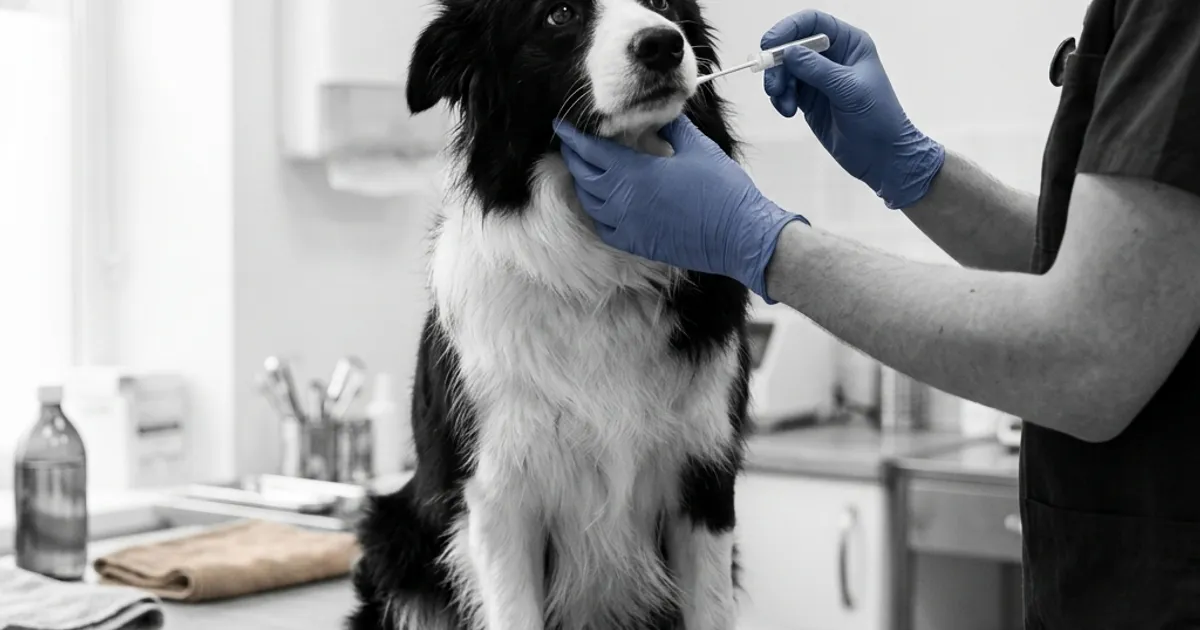
MDR1 Gene Mutation in Border Collies: When One Gene Turns Medicine Into Poison
Many Border Collie owners don’t know to ask their veterinarian about MDR1 status before starting heartworm prevention in spring. That’s a gap worth closing.
The MDR1 mutation (also called the ABCB1 mutation) is widely understood to be a problem primarily in Rough Collies and Australian Shepherds — and the numbers do favor that view. Mutation frequency in Border Collies is genuinely lower. But “lower” is not zero. And a separate ABCB1 variant found at a 24.9% allele frequency in Japanese Border Collies adds a layer of complexity that most guides overlook.
The clinical stakes are real: in a fully affected dog, an over-the-counter anti-diarrheal — the kind a well-meaning owner might grab at a pharmacy — can cause respiratory depression. One gene variant changes the pharmacological profile of dozens of drugs.
P-Glycoprotein: The Blood-Brain Barrier’s Active Gatekeeper
The ABCB1 gene (formerly MDR1, for Multi-Drug Resistance 1) encodes P-glycoprotein (P-gp), an energy-dependent efflux pump embedded in cell membranes. It is expressed in the liver, intestine, kidney, blood-brain barrier (BBB), blood-testis barrier, and placenta — wherever the body needs to actively expel chemical compounds before they accumulate in sensitive compartments.
The BBB function is the most clinically relevant. P-gp in brain capillary endothelial cells intercepts lipophilic drugs before they cross into the brain parenchyma. As long as this mechanism is intact, many drugs remain outside the central nervous system even at high systemic concentrations.
When a loss-of-function mutation disrupts P-gp, that barrier becomes purely structural — a wall with no guards. Drugs that must be kept out of the brain enter freely.
The Molecular Mechanism
The most common variant is a 4-base pair deletion (c.227_230delATAG). This frameshift mutation generates multiple premature stop codons and results in a truncated protein with less than 10% of the normal amino acid sequence — a nonfunctional P-gp (Mealey et al., 2001, Pharmacogenetics).
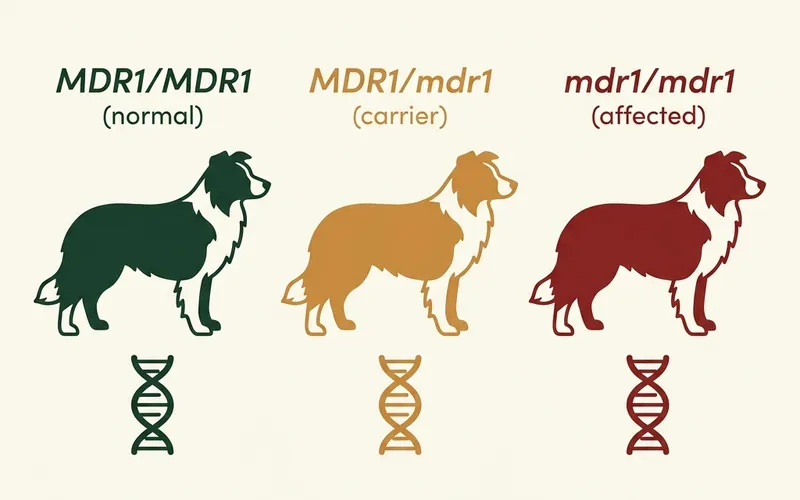
The inheritance pattern is autosomal incomplete dominance. Homozygous mutant dogs (mdr1/mdr1) are fully affected. Heterozygotes (MDR1/mdr1) carry an intermediate level of drug sensitivity that is clinically meaningful at higher drug doses.
The 1873 Ancestor
The origin of the 4-bp deletion was traced in a landmark 2004 PNAS study by Neff and colleagues. Using molecular phylogenetics, the authors concluded that a single dog living in Britain around 1873 is the common ancestor of this mutation across all affected collie-lineage breeds (Neff et al., 2004, PNAS).
That single founder event explains why the same deletion is found in Rough Collies, Australian Shepherds, Shetland Sheepdogs, Border Collies, German Shepherds, Old English Sheepdogs, and at least 13 other breeds. A century and a half of breeding, built on top of one variant.
How Common Is It in Border Collies?
The 4-bp Deletion (Primary Variant)
Border Collies sit at the low end of the affected-breed spectrum.
| Population | Allele Frequency or Prevalence | Source |
|---|---|---|
| Rough Collie (North America) | ~70% | — |
| Australian Shepherd | ~50% | — |
| Shetland Sheepdog | ~15% | — |
| Border Collie (Japan, n=500) | Allele freq. 0.2% | Mizukami et al., 2012 |
| Border Collie (North America) | ~1.6% affected | Paw Print Genetics |
| Border Collie (Germany, n=7,378) | Allele freq. 1% | Marelli et al., 2020 |
| Border Collie (Mexico) | Allele freq. 3.3% | Galindo et al., 2021 |
The Japanese dataset (n=500, Mizukami et al., 2012) returned the lowest reported allele frequency at 0.2%. This data is from 2012; the current frequency after additional imports and lineage diversification is not precisely established.
A Variant Unique to Border Collies: c.-6-180T>G
Here is where the story diverges from the standard collie-lineage narrative.
A single-nucleotide substitution (c.-6-180T>G) in the same ABCB1 gene has been identified at a strikingly high frequency in Japanese Border Collies. In a study of 472 Border Collies (Mizukami et al., 2013), the mutant G allele was present at a frequency of 24.9%. The genotype breakdown: wild-type homozygotes (T/T) 60.0%, heterozygotes (T/G) 30.3%, mutant homozygotes (G/G) 9.8%.
Approximately 40% of the Japanese Border Collie population carries at least one copy of this variant.
This mutation has been associated with phenobarbital-resistant idiopathic epilepsy. As a variant within the same ABCB1 gene, it may alter P-gp function — but a direct causal link to drug hypersensitivity (ivermectin toxicity, etc.) has not been established in the current literature. The data warrant attention; they do not yet warrant equivalent alarm to the 4-bp deletion.
Drugs That Require Caution: The Evidence-Based List
High Risk in Mutant Dogs
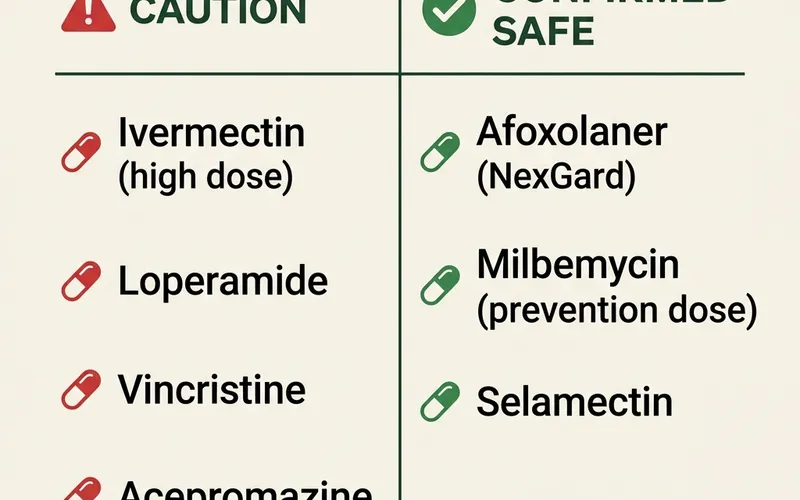
Ivermectin
The drug most associated with MDR1 toxicity in dogs. Toxic threshold in normal dogs: approximately 2.5 mg/kg. In homozygous mutant dogs: as low as 0.1 mg/kg — roughly 25-fold more sensitive (Mealey et al., 2001).
Heartworm prevention doses (approximately 0.006 mg/kg) are generally considered safe even in affected dogs. The problem arises with high-dose regimens used to treat demodicosis or sarcoptic mange (0.3–0.6 mg/kg), which are unambiguously dangerous.
Clinical signs progress through ataxia, hypersalivation, mydriasis, tremors, seizures, bradycardia, respiratory arrest, and coma. Prognosis depends on the dose and speed of supportive intervention.
Loperamide (Imodium)
An over-the-counter antidiarrheal that pet owners commonly — and understandably — assume is safe. In normal dogs, P-gp actively expels loperamide at both the intestine and blood-brain barrier, preventing central opioid receptor activation. In MDR1-deficient dogs, loperamide reaches the brain unimpeded and acts as a full opioid agonist: sedation, respiratory depression, and cardiovascular effects follow.
This is arguably the highest-risk drug in terms of accidental owner-administered exposure. In homozygous mutant dogs, loperamide is absolutely contraindicated.
Vincristine and Doxorubicin (Chemotherapy)
P-gp normally limits CNS and bone marrow exposure to these cytotoxic agents. In MDR1-mutant dogs given vincristine, significantly increased hematologic toxicity (neutropenia, thrombocytopenia) is well documented (Mealey et al., 2003).
A prospective doxorubicin trial was terminated when the first two mutant homozygous dogs developed fatal neutropenic sepsis. Cancer diagnosis in a Border Collie is now considered an indication for MDR1 genotyping before initiating any chemotherapy protocol.
Acepromazine (Tranquilizer)
Commonly used for pre-anesthetic sedation. A controlled study of IV acepromazine in ABCB1-deficient dogs found significantly prolonged and deepened sedation compared to wild-type controls (Lhermette et al., 2016). This has direct implications for surgical anesthesia planning — another reason why genotype information should accompany every anesthetic procedure.
Cyclosporine and Digoxin
Cyclosporine (used for atopic dermatitis and immune-mediated eye disease) and digoxin (cardiac drug) are both P-gp substrates. Increased CNS penetration and reports of neurological signs in mutant dogs warrant dose adjustment and close monitoring.
Drugs Confirmed Safe in MDR1-Mutant Dogs
Afoxolaner (NexGard)
A 2022 controlled study (Drag et al., Journal of Veterinary Pharmacology and Therapeutics) administered afoxolaner at 3.8 times the recommended treatment dose to homozygous MDR1-deficient Collies. No adverse events were observed. The drug crosses cell membranes by passive diffusion rather than P-gp-dependent transport, explaining its safety in affected dogs.
Milbemycin Oxime (at heartworm prevention doses)
Safe at prevention doses. High-dose regimens for mange treatment carry similar caveats to ivermectin.
Selamectin (Revolution)
External application at 40 mg/kg — three to seven times the standard therapeutic dose — produced no adverse effects in mutant dogs in published safety studies (PMC3419875). Among macrocyclic lactones, selamectin appears to carry the lowest neurotoxicity potential in affected dogs.
What to Tell Your Veterinarian
For dogs with known or suspected MDR1 mutation, the following practices are recommended:
- Document genotype in the medical record — request it be noted alongside allergy history
- Confirm before every anesthetic procedure — drug selection and acepromazine use
- Verify doses for all antiparasitic treatments — prevention doses may be safe; treatment doses may not
- Avoid all human OTC anti-diarrheals — loperamide is the primary risk
- Carry a drug sensitivity card — for emergency situations where normal history-taking may not occur
Some owners use collar tags reading “MDR1 MUTANT — DRUG SENSITIVE” to ensure this information is immediately available in any veterinary encounter.
Washington State University’s Veterinary Pharmacology & Toxicology group operates the MDR1Caddie™ portal (prime.vetmed.wsu.edu), a free online tool that allows drug-by-drug safety queries for MDR1-affected dogs.
The Case for Breeder Screening
The 4-bp deletion frequency in Border Collies is low by collie-lineage standards. The argument for screening is not frequency — it is consequence.
Preventing homozygous offspring. A carrier-to-carrier breeding carries a 25% probability of producing homozygous-affected pups. Avoiding carrier × carrier pairings eliminates this outcome without requiring that carriers be removed from breeding populations entirely — a reasonable balance between health management and genetic diversity preservation.
Enabling informed ownership. Buyers whose dogs carry one or two copies of the variant need to communicate that information to their veterinary team. Without a documented genotype, that information is absent.
Complementing a comprehensive testing panel. For breeds where ABCB1 and other heritable conditions exist, single-gene testing in isolation misses the picture. A panel approach — MDR1 alongside Collie Eye Anomaly, Trapped Neutrophil Syndrome, Imerslund-Gräsbeck Syndrome, and Hereditary Cataract — reflects current best practice.
In Japan, Kahno Techno (kahotechno.co.jp) offers a five-variant Border Collie panel (CL, CEA, TNS, MDR1, IGS) via veterinary clinic referral. International options include Washington State University/WADDL, UC Davis Veterinary Genetics Laboratory, Paw Print Genetics, and Embark Veterinary.
Begin with the Data
The assumption that a Border Collie is unaffected is not the same as knowing it.
A 1–2% mutation frequency still means that in any group of 100 Border Collies, one or two carry the classic 4-bp deletion. The Japan-specific c.-6-180T>G variant is carried by roughly 40% of Japanese Border Collies, and its clinical significance continues to be investigated. Genotyping, done once, provides lifetime guidance for veterinary care decisions.
Drug accidents caused by unrecognized MDR1 status are preventable. The science is there. Using it is a choice.
Genotype is lifetime medical information. It is worth confirming before a drug decision has to be made under pressure.
About ROSCH KENNEL: A Border Collie breeding kennel located in Kirishima, Kagoshima, within one of Japan’s oldest national parks. All breeding dogs undergo 15+ point genetic testing, with full results published publicly.
References
- Mealey KL et al. (2001). Ivermectin sensitivity in collies is associated with a deletion mutation of the mdr1 gene. Pharmacogenetics. PMID 11692082
- Neff MW et al. (2004). Breed distribution and history of canine mdr1-1Δ, a pharmacogenetic mutation that marks the emergence of breeds from the collie lineage. PNAS. doi:10.1073/pnas.0402374101
- Mealey KL et al. (2003). Increased toxicity of P-glycoprotein-substrate chemotherapeutic agents in a dog with the MDR1 deletion mutation associated with ivermectin sensitivity. Journal of the American Veterinary Medical Association. PMID 14627096
- Mizukami K et al. (2012). Rapid genotyping assays for the 4-base pair deletion of canine MDR1/ABCB1 gene and low frequency of the mutant allele in Border Collie dogs. Journal of Veterinary Diagnostic Investigation. PMID 22362942
- Mizukami K et al. (2013). High Frequency of a Single Nucleotide Substitution (c.-6-180T>G) of the Canine MDR1/ABCB1 Gene Associated with Phenobarbital-Resistant Idiopathic Epilepsy in Border Collie Dogs from Japan. PLoS ONE. PMC3834651
- Galindo EY et al. (2021). Frequency of the ABCB1 gene mutation in Border Collie dogs from Mexico. Veterinary Mexico OA. doi:10.22201/fmvz.24486760e.2021.844
- Drag M et al. (2022). Safety of oral afoxolaner formulated with or without milbemycin oxime in homozygous MDR1-deficient collie dogs. Journal of Veterinary Pharmacology and Therapeutics. PMC9543253
- Lhermette KE et al. (2016). The Effect of the Canine ABCB1-1Δ Mutation on Sedation after Intravenous Administration of Acepromazine. PLoS ONE. PMC4913601
- Marelli S et al. (2020). Genotypic and allelic frequencies of MDR1 gene in dogs in Italy. Veterinary and Animal Science. PMC7319724
- Paw Print Genetics. Multidrug Resistance 1 (MDR1 / ABCB1). pawprintgenetics.com
- Washington State University Veterinary Pharmacology & Toxicology. MDR1 Testing. prime.vetmed.wsu.edu
- UC Davis Veterinary Genetics Laboratory. Multidrug Sensitivity (MDR1). vgl.ucdavis.edu
Daily observation is where the next article begins.
Instagram shows the dogs in daily life. The journal turns the themes we notice there into evidence-aware resources.