


Teaching a Border Collie to Come When Called — Where Herding Instinct Meets Behavioral Science
One of the first walls Border Collie owners hit is the recall — or more precisely, the lack of one. Stanley Coren’s landmark study The Intelligence of Dogs (1994) ranked Border Collies first among 131 breeds in working and obedience intelligence. So why won’t this dog come when called? The answer, paradoxically, lies in that very intelligence.
How Herding Instinct Hijacks the Recall — A Neurological Perspective
Understanding Border Collie behavior requires looking at the genetic foundation. A 2025 study published by NIH/PMC (PMC12042896) identified a specific enrichment of genes related to cognitive control and motor precision in herding-line Border Collies. Notably, a herding-line-specific haplotype of the EPHB1 gene is associated with amplified chase-and-fixation patterns — the neurological core of the “eye, stalk, chase, grip” predatory motor sequence that defines herding behavior.

When this herding drive is activated — triggered by a moving car, bicycle, child, or other dog — the dog’s attention locks onto the target. The brain is in “pursuit mode.” A recall in that moment is not merely a communication challenge. It is a neurophysiological intervention: asking the brain to interrupt a deeply wired reward circuit. Framing recall failure as “disobedience” or “stubbornness” misses the point. Understanding it as a neurological challenge is what allows trainers to work with the dog rather than against it.
The Science of Recall: Operant Conditioning Fundamentals
Recall training rests on B.F. Skinner’s model of operant conditioning — the principle that behavior is shaped by its consequences. The relevant quadrants for recall work are:
| Type | Mechanism | Application to Recall |
|---|---|---|
| Positive reinforcement | Add reward after behavior → behavior increases | Give high-value treat the moment the dog returns |
| Negative reinforcement | Remove aversive after behavior → behavior increases | Release leash tension when dog moves toward owner |
| Positive punishment | Add aversive after behavior → behavior decreases | Scolding upon return (contraindicated) |
| Negative punishment | Remove reward after behavior → behavior decreases | End play if dog does not recall |
Positive reinforcement is the recommended approach. The American Kennel Club defines a “reliable recall” as a dog that responds to the owner’s call 99.99% of the time, and notes that consistent positive reinforcement is the only method that reliably achieves this standard over the long term (AKC, “Reliable Recall: Train Your Dogs to Come When Called”).
Reinforcer Selection: What You Reward Determines What You Get
Not all rewards are equal. Applied animal behavior research consistently demonstrates that reward quality directly impacts recall success rates. High-value food rewards — boiled chicken, salmon, cheese — significantly outperform standard kibble in establishing reliable recall, and consistent reward delivery determines behavioral stability.
For most Border Collies, the reinforcer hierarchy tends to be:
- High-protein food rewards — boiled chicken, freeze-dried liver, quality soft treats
- Toy-based play rewards — frisbee, ball (satisfies the “chase → retrieve” drive)
- Social rewards — physical contact, verbal praise
A critical principle: keep the recall command’s reward at the highest possible value. If high-value treats are distributed throughout the day for other behaviors, their relative value drops. The dog should learn that hearing “come” is the exclusive signal for the best possible outcome.
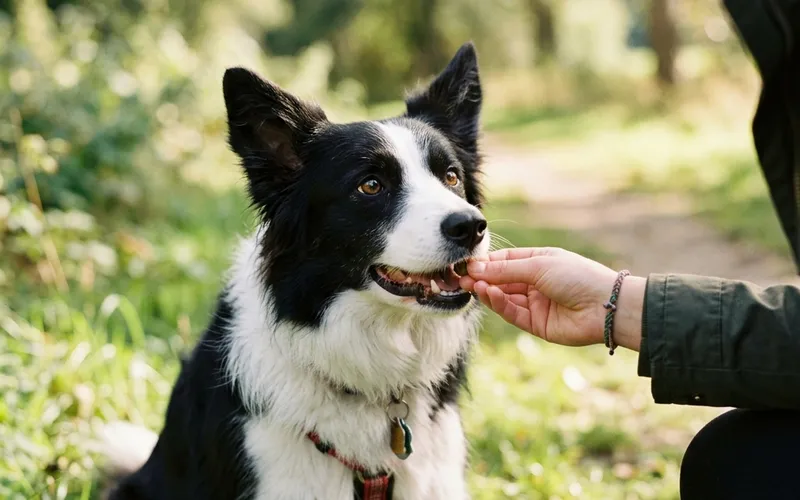
A Phased Training Protocol
Recall is not taught in a dog park. The following progressive framework builds reliability by controlling environmental stimuli.
Phase 1: Indoor Conditioning (Ideal: 8–16 weeks)
Begin by pairing the recall command with rewards in a low-distraction environment.
- Issue the command once — never repeat it
- Deliver the reward within 1 second of the dog reaching you (timing is everything)
- Keep sessions short: 5–10 repetitions, 3–5 minutes total
- Start at a distance where success is guaranteed (3–6 feet / 1–2 meters)
Phase 2: On-Leash Outdoor Training
Move to a yard or low-stimulation outdoor space. Use a long line (15–20 feet / 5–6 meters) for safety.
- Never use the long line to physically pull the dog back — it’s a safety net only
- Progress to greater distance only when success rate exceeds 80%
- On failure: reduce distance, do not punish
Phase 3: Recall Under Distraction (Herding Triggers)
This is the critical phase for Border Collies. Do not attempt Phase 3 until Phases 1 and 2 are solid.
- Begin at a distance from the trigger where the dog notices but does not react (the “threshold” distance)
- Recall from this distance; reward heavily on success
- Use systematic desensitization: gradually decrease the distance to the trigger across sessions
- Use the highest-value rewards at this phase
Phase 4: Off-Leash Training
Practice off-leash recall only in enclosed, fenced areas. Open, unfenced environments — roads, parks — should not be used until Phase 4 is fully established.
Five Common Recall Mistakes
1. Punishing the dog for a slow return
Scolding a dog that finally came back — no matter how long it took — creates a “returning = unpleasant outcome” association. The next recall will be worse. Always reward the return, even a late one.
2. Repeating the command
Calling “come, come, come, come” teaches the dog that the word is optional. Issue the command once. If there is no response, close the distance, use movement (turn and jog away), or change the approach — but do not repeat the verbal command.
3. Making recall the end of fun
If recall consistently leads to leash-up and end of play, the dog learns “come = fun is over.” Intersperse recalls that are followed by releasing the dog back to play. The call should never reliably predict the end of something good.
4. Over-relying on aversive tools
A 2014 study published in the Journal of Veterinary Behavior (PubMed ID: 25184218) compared 63 dogs trained with remote electronic collars versus reward-based methods. The reward-based group showed significantly lower rates of stress behaviors, greater environmental engagement, and lower cortisol (stress hormone) elevations. Aversive methods may produce short-term compliance at the cost of the dog’s trust and long-term behavioral stability.
5. Expecting adult reliability from an adolescent
Border Collies reach full neurological maturity around 2 years of age. The adolescent period (approximately 6–18 months) often produces apparent regression — behaviors that seemed established suddenly disappear. This is not failure; it reflects nervous system reorganization. Maintain consistent training through this period without increasing pressure.
Working Line vs. Show Line: Does Lineage Affect Training?
Border Collies split broadly into herding-purpose working lines and conformation show lines, and this distinction matters for training.
The 2025 NIH/PMC genomic study (PMC12042896) found that working-line dogs show enrichment for cognitive control and precision-movement genes, while show-line dogs show enrichment for craniofacial structure genes. This suggests that working-line Border Collies are more likely to exhibit stronger herding-circuit activation, making Phase 3 (distraction-based recall) a longer and more intensive process.
The flip side: the same cognitive capacity that produces stronger prey drive also enables faster, more durable learning once the right conditions are established. Working-line dogs are not “harder to train” — they require training that respects the intensity of their internal motivation.
Conclusion
For a Border Collie, chasing a moving target is not misbehavior — it is the expression of thousands of years of selective breeding. Recall training does not suppress this drive; it asks the dog to learn that returning to the owner is worth more than the chase.
That learning takes time. The sessions are repetitive. But the science is settled: consistent positive reinforcement, high-value rewards, and progressive exposure to distraction reliably produce a dog that can be trusted off-leash. Reliable recall is what turns freedom into something safe.
About ROSCH KENNEL: A specialist Border Collie breeder located within the Kirishima-Kinkowan National Park, Kagoshima Prefecture, Japan — at 2,460 ft (750 m) above sea level. All breeding dogs undergo 15+ genetic health tests, with all results published publicly. Early Neurological Stimulation (ENS) is performed on every litter.
References
-
Coren, S. (1994). The Intelligence of Dogs. Free Press.
-
American Kennel Club. “Reliable Recall: Train Your Dogs to Come When Called.” AKC.org. https://www.akc.org/expert-advice/training/reliable-recall-train-dogs-to-come-when-called/
-
American Kennel Club. “Operant Conditioning and Positive Reinforcement Dog Training.” AKC.org. https://www.akc.org/expert-advice/training/operant-conditioning-positive-reinforcement-dog-training/
-
Masson, S., et al. (2018). “Choke, prong and shock collars: behavioral and physiological effects on dogs during training.” Applied Animal Behaviour Science, 203, 71–83. https://doi.org/10.1016/j.applanim.2018.02.022
-
Cooper, J.J., et al. (2014). “The welfare consequences and efficacy of training pet dogs with remote electronic training collars in comparison to reward based training.” Journal of Veterinary Behavior. PubMed ID: 25184218. https://pubmed.ncbi.nlm.nih.gov/25184218/
-
Bhatt, D., et al. (2025). “Genomic signatures of herding behavior in Border Collies.” PMC/NIH. PMC12042896. https://pmc.ncbi.nlm.nih.gov/articles/PMC12042896/
-
American Border Collie Association. “Training Resources.” ABCA. https://americanbordercollie.org/
Daily observation is where the next article begins.
Instagram shows the dogs in daily life. The journal turns the themes we notice there into evidence-aware resources.