
Border Collie Shedding Season Guide: Managing Blowouts and the Science of Coat Care
Every spring, Border Collie owners encounter the same phenomenon: every brush stroke releases waves of fur, sofas disappear under a layer of hair, and panic sets in. “Is my dog sick?” is among the first questions asked. Some owners take their dogs for a short clip to “help them cool down.” Both responses stem from misunderstanding what a Border Collie’s coat is, what it does, and what shedding actually is.
This guide explains the biology of the double coat, what triggers shedding, how to manage it properly, and why shaving is one of the more damaging things an owner can do to their dog’s coat.
The Double Coat: A Two-Layer System
Border Collies carry a dense double coat composed of two distinct layers:
- Guard coat (outer layer): Long, coarser hairs that repel water, dirt, and UV radiation. They also prevent the undercoat from tangling into mats.
- Undercoat (inner layer): Short, soft, densely packed fibers that trap air close to the skin and act as insulation against both cold and heat.
The double coat functions like a thermos: the air trapped between layers keeps heat out in summer and warmth in during winter. The American Kennel Club’s official breed standard describes the Border Collie’s coat as “weather-resistant” and “dense.” The undercoat is what sheds in large volumes during a shedding season.
What Triggers Shedding: Photoperiod and Hormones
Shedding is not triggered by rising temperatures. The primary trigger is the change in day length (photoperiod).
The dog’s retina detects changes in daylight duration and signals the pineal gland in the brain. The pineal gland produces melatonin, whose levels shift with the seasons:
- Spring (days lengthen): Melatonin production decreases; prolactin levels rise. This hormonal shift triggers the release of the winter coat and transition to a lighter summer coat.
- Fall (days shorten): Melatonin increases, signaling growth of the denser winter coat.
Indoor dogs exposed to artificial lighting and stable indoor temperatures may receive weaker seasonal signals, leading to a more diffuse, year-round shedding pattern rather than two concentrated blowouts.
Annual Shedding Pattern
| Season | Transition | Duration |
|---|---|---|
| Spring (March–June) | Winter coat → lighter summer coat | 4–6 weeks |
| Fall (September–November) | Summer coat → denser winter coat | 3–4 weeks |
Spring sheds tend to be heavier and longer than fall sheds, as the full winter undercoat accumulated over months is released at once.
Brushing During Shedding Season: Tools and Frequency
The most important management strategy during a shedding season is removing loose coat before it mats. When shed coat accumulates against the skin, air circulation is blocked and a warm, moist environment develops—ideal conditions for bacteria and fungi.
Recommended Tools
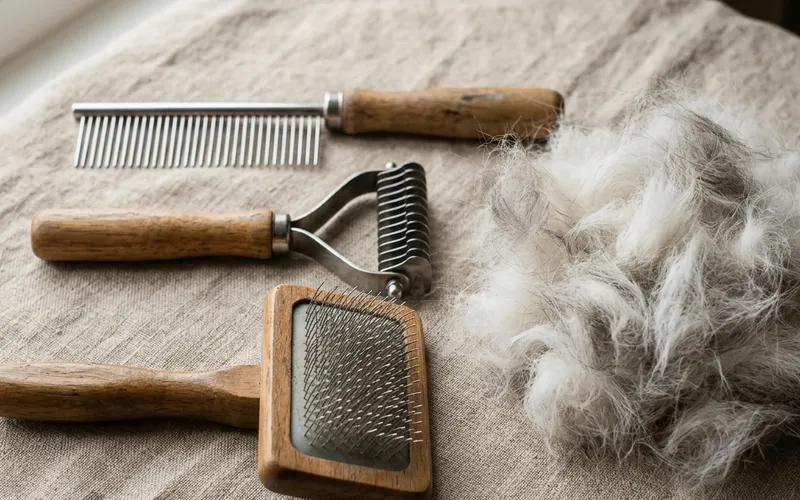
Slicker brush Fine metal pins that work through the outer coat, detangle, and collect loose surface hair. The basic tool for daily brushing.
Undercoat rake / deshedding tool Toothed metal blades that penetrate into the undercoat layer and extract loose inner fibers. Highly effective during blowouts. Avoid overuse, which can damage the guard coat.
Wide-tooth comb Used to gently work through existing tangles before brushing. Effective as a pre-brush step on problem areas.
Recommended Brushing Frequency
| Period | Frequency |
|---|---|
| Non-shedding season | 1–2 times per week |
| Shedding season (4–6 weeks) | Daily |
| Professional grooming | Every 8–12 weeks (increase frequency during shedding season) |
Daily brushing during blowout periods is not optional—it directly prevents mat formation and the secondary skin problems that follow.
Why Shaving Is Harmful
The “summer cut”—shaving or closely clipping a double-coated dog for summer—is widespread but unsupported by veterinary evidence. It rests on the false assumption that less fur equals cooler dog.
It Disrupts Temperature Regulation
As described above, the double coat insulates in both directions. The air gap between guard coat and skin keeps external heat from reaching the skin in summer. When the coat is shaved, this buffer disappears, and the skin is exposed directly to ambient temperature and radiant heat.
Dr. Jerry Klein, Chief Veterinary Officer of the AKC, has stated that shaving double-coated dogs can predispose them to heatstroke and causes hair follicle damage.
Shaving also removes UV protection. Dog skin—particularly lightly pigmented areas—is vulnerable to ultraviolet radiation. The guard coat provides a significant barrier. Without it, sunburn and increased risk of skin cancer are documented concerns.
Post-Clipping Alopecia
One of the most serious long-term consequences of shaving is post-clipping alopecia—a failure of normal coat regrowth following close clipping.
When a double coat is clipped close to the skin, the physical trauma to follicles can push them into an extended resting phase (telogen), halting new hair production. Documented characteristics, reported by multiple veterinary institutions including Cornell University’s Riney Canine Health Center, include:
- 6 to 24 months may be required before coat regrowth
- Regrown coat may differ in texture, color, and density
- In severe cases, the coat never fully recovers its original protective structure
Additionally, because the undercoat typically regrows faster than the guard coat, shaving can permanently alter the ratio between the two layers—leaving an overly dense undercoat without adequate guard hair protection.
The correct response to a heavy shed is thorough brushing, not shaving.
Nutritional Support During Shedding Season
Coat quality is directly influenced by diet. Omega-3 fatty acids—specifically EPA (eicosapentaenoic acid) and DHA (docosahexaenoic acid)—have the strongest evidence base for supporting coat and skin health in dogs.
Mechanisms
Omega-3 fatty acids provide:
- Structural support for hair follicle cell membranes, facilitating healthy hair growth
- Anti-inflammatory effects, reducing skin hypersensitivity during the shedding period
- Improved skin barrier function, reducing water loss and flaking
A prospective study published in ScienceDirect (2020) documented improvements in coat luster and skin condition with omega-3 supplementation. Earlier work by Logas and Kunkle (Veterinary Dermatology, 1994) demonstrated benefits in dogs with pruritic skin conditions. Measurable improvement typically requires 4–8 weeks of consistent supplementation.
Recommended Sources
- EPA/DHA: Cold-water fish (salmon, sardines, mackerel) or fish oil supplements. More bioavailable than plant-based ALA.
- ALA (flaxseed oil): Conversion to EPA/DHA is inefficient in dogs; useful as supplemental support only.
Consult a veterinarian to determine appropriate dosing for your dog’s weight.
Skin Conditions to Monitor During Shedding Season
The shedding period increases the risk of several skin conditions, most of which are preventable with consistent grooming.
Folliculitis
Bacterial infection of hair follicles, often secondary to mat accumulation or poor hygiene. Symptoms include pustules, crusting, and localized hair loss. Treatment typically involves antibacterial shampoos or oral antibiotics.
Seborrhea
Abnormal sebum production causing greasy or flaky skin. Often worsens during shedding season when combined with allergies or nutritional deficiencies. Requires medicated shampoo and management of the underlying cause.
Mat-Related Secondary Infections
Mats block airflow and trap moisture against the skin. Dogs respond to the discomfort by licking or chewing the area, introducing bacteria. Preventing mat formation through daily brushing is the most effective prevention strategy.
Shedding Season Checklist
Use this as a practical reference during spring (March–June) and fall (September–November) shedding periods:
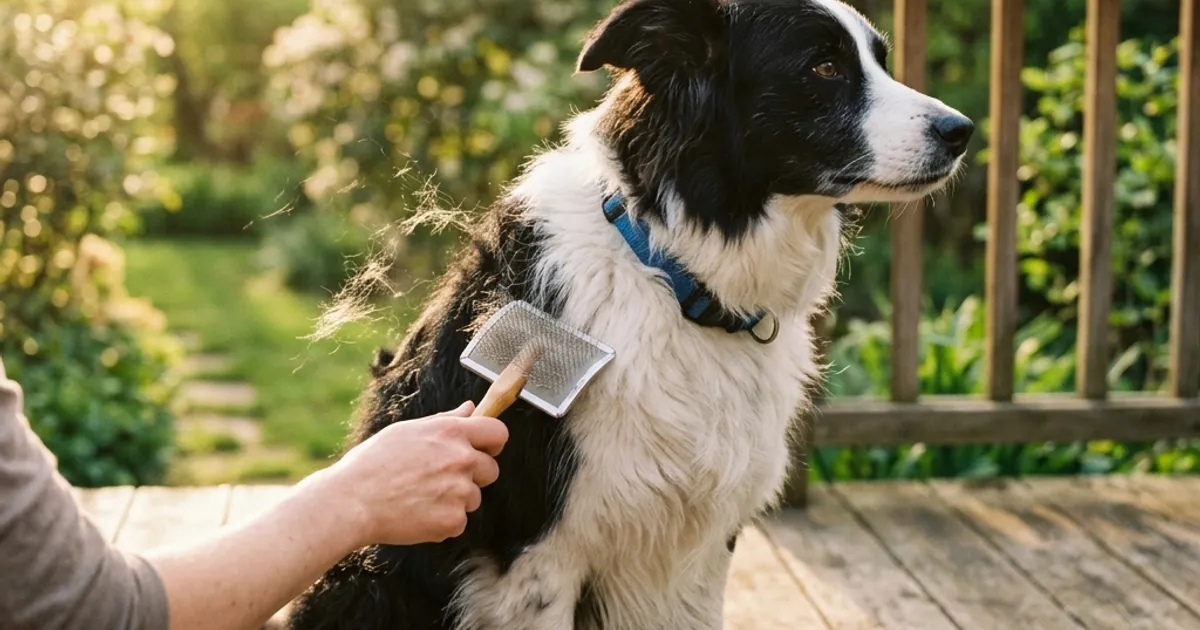
- Daily brushing (slicker brush, then undercoat rake)
- Bathing every 2–4 weeks during the season (maintains cleanliness without stripping natural oils)
- Omega-3 supplementation continued for 4+ weeks
- Mats addressed the same day they appear
- Consult a veterinarian if you observe redness, pustules, or excessive scratching
- No shaving or close clipping
A Border Collie’s shedding season is predictable, manageable, and—with the right knowledge—nothing to dread.
About ROSCH KENNEL: A Border Collie specialty breeder based in Kirishima-Kinkowan National Park, Kagoshima, Japan (elevation 750m / 2,460ft). All breeding dogs undergo 15+ genetic health tests, with results publicly disclosed. ENS (Early Neurological Stimulation) is practiced in every litter.
References
- American Kennel Club (AKC). Border Collie Breed Standard. https://images.akc.org/pdf/breeds/standards/Border_Collie.pdf
- American Kennel Club (AKC). Is It OK to Shave Your Dog? Klein, J. https://www.akc.org/expert-advice/health/is-it-ok-to-shave-your-dog/
- American Kennel Club (AKC). Dog Shedding: What to Expect and How to Manage It. https://www.akc.org/expert-advice/health/dog-shedding-what-to-expect-and-how-to-manage-it/
- Animal Allergy & Dermatology Center of Colorado. Post-Clipping Alopecia. https://animalallergycolorado.com/animal-disease-index/postclipping-alopecia
- Edition Dog Magazine. Understanding Canine Fur: The Science of Seasonal Shedding. https://editiondog.com/blogs/paws-the-word/understanding-canine-fur
- Frontiers in Veterinary Science (2022). Melatonin and Seasonal Alopecia in Dogs. https://www.frontiersin.org/journals/veterinary-science/articles/10.3389/fvets.2022.956630/full
- Hill’s Pet Nutrition. Fatty Acids for Dogs: Benefits of Omega-3 and Omega-6. https://www.hillspet.com/dog-care/nutrition-feeding/fatty-acids-for-dogs
- Logas, D., & Kunkle, G.A. (1994). Double-blinded crossover study with marine oil supplementation containing high-dose icosapentaenoic acid for the treatment of canine pruritic skin disease. Veterinary Dermatology, 5(3), 99–104.
- MDPI Animals (2025). Photoperiod Management in Companion Animals. https://www.mdpi.com/2076-2615/15/4/591
- Merck Veterinary Manual. Seborrhea in Dogs. https://www.merckvetmanual.com/dog-owners/skin-disorders-of-dogs/seborrhea-in-dogs
- ScienceDirect (2020). Prospective study on omega-3 fatty acid supplementation and canine coat quality. https://www.sciencedirect.com/science/article/pii/S0952327820300983
- Veterinary Practice. Melatonin and Seasonal Alopecias in Dogs. https://www.veterinary-practice.com/article/melatonin-and-seasonal-alopecias
- WagWalking. Post-Clipping Alopecia in Dogs. https://wagwalking.com/condition/post-clipping-alopecia
Daily observation is where the next article begins.
Instagram shows the dogs in daily life. The journal turns the themes we notice there into evidence-aware resources.