

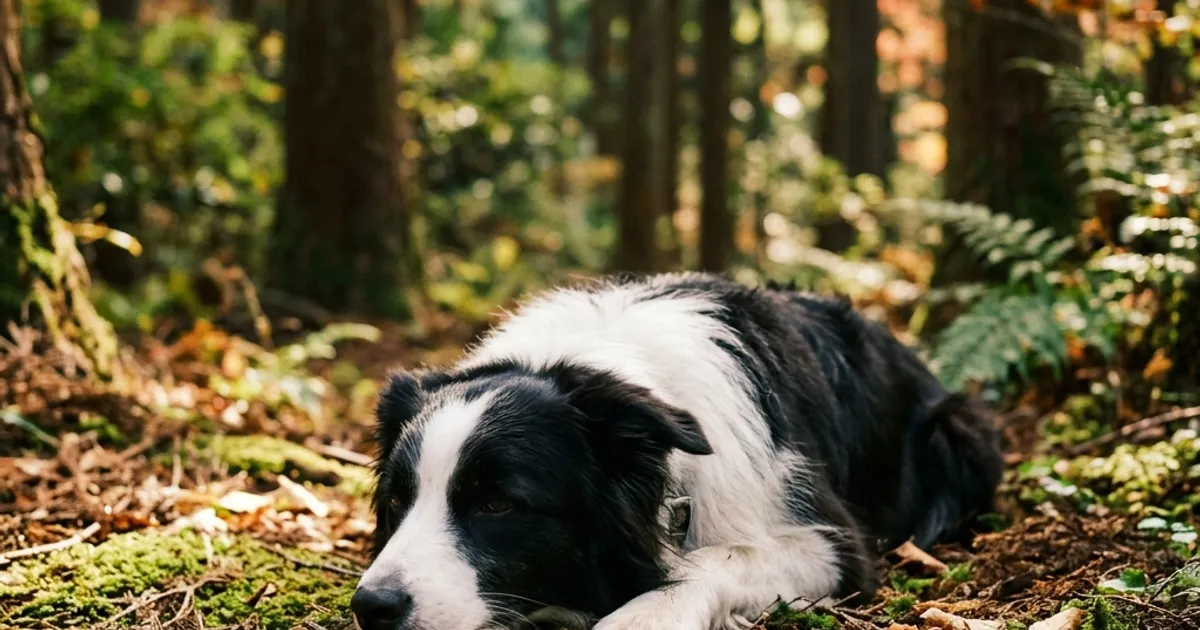
More Exercise Won't Fix Your Border Collie — The Science of Overstimulation and Mental Enrichment
“We walk him for an hour every morning, but the moment we get home he’s bouncing off the walls.”
“We bought every puzzle toy on the market. He’s more wound up than ever.”
These are common refrains from Border Collie owners. Here’s the direct answer: this isn’t a symptom of under-exercise. It’s overstimulation — and more activity is the last thing it needs.
The mainstream advice around Border Collies consistently points in one direction: exercise more, stimulate more. But experienced trainers in the UK and US have been shifting the conversation. The missing piece isn’t more stimulation. It’s teaching the dog how to switch off.
This article examines the neuroscience of Border Collie cognition, explains why well-intentioned enrichment can become a trap, and outlines five evidence-based approaches that work.
The Science Behind Border Collie Intelligence

Psychologist Stanley Coren (University of British Columbia) surveyed 208 professional obedience trial judges and ranked 120 breeds by working and obedience intelligence. Border Collies placed first (Coren, 1994).
But what does “most intelligent” actually mean in practice?
Dr. John W. Pilley (Wofford College, South Carolina) conducted a longitudinal study with a Border Collie named Chaser. Over three years of formal training leading to the 2011 publication, Chaser learned to identify 1,022 individual objects by name — the largest tested vocabulary of any non-human animal on record. She also demonstrated understanding of three-element sentences containing a preposition, verb, and direct object (e.g., “Take the ball to the Frisbee”) — a level of syntactic comprehension that had not previously been documented in dogs (Pilley & Reid, 2011; Pilley, 2013).
A 2022 study published in Scientific Reports tested 1,002 dogs across 13 breeds using standardized cognitive batteries. Border Collies achieved the highest scores on inhibitory control (the cylinder test), with the researchers noting this likely reflects evolutionary pressure: a herding dog must suppress predatory impulses while maintaining precise control over livestock (Junttila et al., 2022).
The most recent genomic data reinforces this picture. A study published in Science Advances (Jeong et al., 2025) identified 24 genes significantly associated with herding behavior. The gene EPHB1 (Ephrin type-B receptor 1), linked to locomotor hyperactivity and spatial memory, showed the strongest signal. Work-type Border Collies carrying a specific EPHB1 haplotype demonstrated significantly elevated toy-stalking, chasing, and grab-biting behaviors.
The herding instinct, in other words, is not a vague predisposition. It is a genetically encoded behavioral sequence: eye → stalk → chase → complete. This sequence doesn’t disappear in a domestic environment. It looks for outlets.
The Overstimulation Trap
The problem begins with a logical-sounding loop: the dog is wound up, so we exercise more. The dog adapts to that level of exercise, so we add more. Eventually, you’ve created an athlete who’s physically incapable of resting.
A commonly cited observation in UK training circles captures it precisely:
“You end up in a vicious cycle of having to exercise your dog more and more just to keep them calm, because you’ve never taught them how to settle themselves.”
Sustained elevated heart rate, cortisol, and adrenaline gradually recalibrate the nervous system’s baseline. The dog doesn’t know any other way to be. Stimulation — even mental stimulation through puzzle toys — can reinforce this arousal if it’s delivered without structure or recovery time.
Signs of Overstimulation
If three or more of these are present, overstimulation is worth considering:
- Destroys puzzle toys rather than solving them
- Can’t settle after play; paces or seeks contact repeatedly
- Barking increases after enrichment activities
- Pulls constantly on leash; reacts to everything
- Poor sleep, restlessness in the evening
- Obsessive fixation on shadows, reflections, or moving lights
That final sign warrants particular attention. A large-scale study of 13,700 Finnish pet dogs (Scientific Reports, Salonen et al., 2020) found that Border Collies showed significantly higher rates of “compulsive visual fixation” — the obsessive tracking of lights and shadows — compared to other breeds. This is sometimes interpreted as an empty loop of the herding behavioral sequence — the chase initiated but never completed. Some behavioral scientists suggest that accumulated overstimulation may worsen these patterns, though the causal relationship is not yet firmly established.
Five Evidence-Based Enrichment Approaches
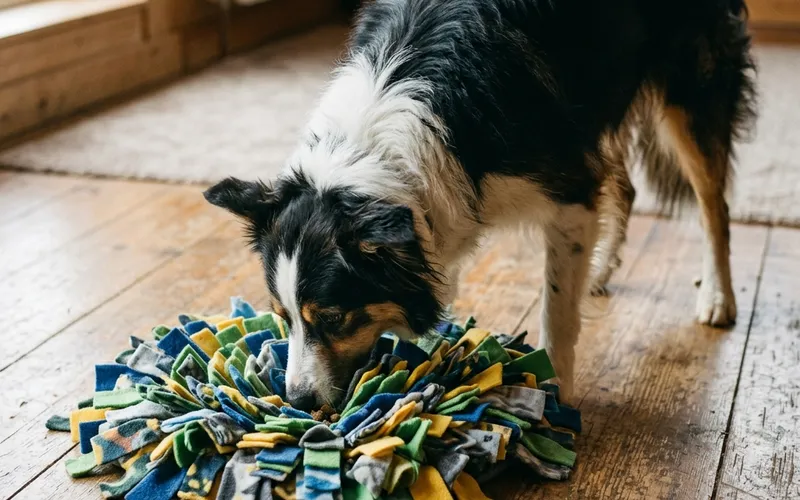
The goal of enrichment is not to maximize stimulation. It is to use the nervous system appropriately and allow it to recover.
1. Nosework — The Most Efficient Brain Drain
In 2019, Duranton & Horowitz published a controlled study in Applied Animal Behaviour Science that deserves attention from every Border Collie owner. Dogs were randomly assigned to two groups: two weeks of nosework training or two weeks of heel training. Before and after, researchers measured cognitive bias — a validated proxy for emotional state. The nosework group showed a significant shift toward optimistic judgment. The heel training group showed no change (Duranton & Horowitz, 2019).
Dogs have roughly 40–50 times more olfactory receptors than humans, with olfactory sensitivity estimated at 10,000 times or greater depending on breed and methodology. Engaging the olfactory system activates prefrontal processing at a level distinct from visual or auditory tasks, producing significant cognitive load even in short sessions.
Progressive nosework levels:
- Level 1: Three cups, one treat hidden underneath. Let the dog find it with their nose
- Level 2: Hide food in 5–8 spots around a room; give a “find it” cue
- Level 3: Snuffle mat (10–15 min) — embed dry food into fabric channels
- Level 4: Outdoor tracking — target a specific scent (anise, birch, clove) and find the hide
The moment of finding should be celebrated with genuine enthusiasm. This reinforces the desire to keep searching.
2. Puzzle Feeders — With Caveats
Puzzle feeders have solid early support. A 2008 study in Applied Animal Behaviour Science (Schipper et al.) found that feeding enrichment toys increased appetitive behavior, reduced inactivity, and lowered stereotypic behaviors in kenneled dogs.
However, a 2023 systematic review (PMC10648485) noted that these effects are not consistently replicated in companion dogs. In dogs already running at high arousal, presenting a challenging puzzle can escalate frustration rather than provide relief.
Guidelines for effective use:
- Use puzzle feeders for meals, not treats — this keeps total calorie intake controlled
- Only offer them when the dog is calm, not after an exciting walk or play session
- If frustration signs appear (pawing, whining, abandonment), simplify immediately
- Keep sessions to 15–20 minutes; longer sessions can build arousal rather than drain it
3. Settle Training — The Skill Most Owners Skip
This is the most important item on this list. It is also the one almost entirely absent from mainstream dog advice.
Settling is not a passive state. It is a learned skill.
The method:
- The moment the dog lies down voluntarily, quietly deliver a treat to their nose — no big fuss, no excited praise
- Repeat this consistently so the dog begins to associate lying down with calm reward delivery
- Introduce a specific location (a mat or blanket): gesture toward it when the dog is in a settled state
- Add a verbal cue (“settle” or “mat”) after the behavior is reliable
- Gradually extend the duration by waiting slightly longer before delivering each treat
The critical rule: reward in the settled state, never after excitement. Any reward delivery that increases arousal retrains the wrong thing.
Some behavioral specialists advocate starting this rhythm early — during the socialization period (weeks 3–16). Providing puppies access to both stimulating zones and quiet retreat spaces may support the development of voluntary rest behavior. It should be noted, however, that the evidence for early stimulation programs remains mixed, with some peer-reviewed studies finding no statistically significant differences in developmental outcomes.
4. Channeling Herding Instinct
The four-stage herding sequence — eye, stalk, chase, complete — is hardwired. The question is not whether it will activate, but where it will be directed.

Activities that channel the full sequence:
- Disc (Frisbee): The disc provides visual tracking (eye), an approach (stalk), flight chase, and a catch (complete). All four stages activate and resolve
- Flirt pole (lure wand): The handler controls speed and direction, making it easier to prevent over-arousal while still running the sequence
- Recall + down: Redirect the chase impulse into a precision command — call the dog at full run, ask for a down at your feet
The essential principle is completion. Games that leave the sequence unresolved — where the dog never catches anything, or play ends mid-chase — accumulate frustration. Every game should have a defined endpoint that the dog reaches.
5. Pattern Games — Engineering the Off Switch
Pattern games are a structured approach to regulating arousal systematized by Leslie McDevitt in Control Unleashed (2007) and widely adopted in behavioral training.
Up/Down:
- On “up,” ask for a physically engaged behavior (jumping a low target, spinning, a quick recall)
- On “down,” ask for a down-stay
- Alternate in rapid succession, three to five rounds
- End on “down” and reward calm stillness
This trains the dog to respond to internal arousal by switching gears on cue — not suppressing energy, but redirecting it into a behavior that has a defined bottom. Over time, dogs who practice this regularly show faster recovery from excitement in real-world situations.
Lifelong Training Protects Cognitive Health
Mental enrichment is not only for puppies.
A longitudinal study of 185 dogs, including 75 Border Collies (Wallis et al., 2017, Frontiers in Aging Neuroscience), found that dogs with higher lifelong training scores showed significantly less age-related decline in attentiveness. The effect was robust: the difference between well-trained and less-trained dogs in attentional performance was substantial by late senior age.
The principle is the same as in human cognitive neuroscience: use it or lose it.
Training is not something you finish when the dog reaches adulthood. It’s something you continue. The daily mental challenge — a short nosework session, a settle cue before dinner, a pattern game on the walk — compounds over years into a dog with a clear, stable mind well into old age.
Spring Is the Season to Stay Disciplined
As temperatures rise and outdoor activity increases, spring is the time when owners most naturally shift toward doing more — longer walks, more playtime, more stimulation. But for Border Collies, this seasonal impulse deserves deliberate management.
Spring environments are rich in natural sensory change: new growth, wet soil, pollen, insects. A slow-paced walk where the dog is allowed to stop and investigate at its own pace — sniff-led rather than pace-led — engages the olfactory system deeply without adding aerobic load. Building on the positive-affect findings of Duranton & Horowitz (2019), practitioners often extend the principle to informal sniffing walks — though direct evidence comparing structured nosework with unstructured outdoor sniffing remains limited.
The season of expanding activity is also the right time to intensify settle training. The contrast between high outdoor stimulation and a calm indoor environment creates the exact conditions where the off switch becomes most valuable.
A Sample Daily Enrichment Schedule
| Time | Activity | Purpose |
|---|---|---|
| Morning (wake) | Snuffle mat, 15 min | Gradual arousal with olfactory engagement |
| Mid-morning | Walk 30–40 min (sniff-led, not pace-led) | Natural scent exploration |
| Midday | Settle training, 10 min | Reinforce the off switch |
| Afternoon | Flirt pole or disc, 15 min | Channeling, with a defined endpoint |
| Early evening | Obedience or pattern games, 10 min | Cognitive load, controlled |
| Evening | Lick mat (frozen kefir or pumpkin) | Parasympathetic activation, calm wind-down |
An adult Border Collie does not need two hours of running per day. What it needs is structured variety: olfactory load, cognitive challenge, physical release through channeled play, and deliberate, repeated practice of settling.
Summary
The premise that “more exercise = calmer dog” breaks down quickly with Border Collies. The nervous system adapts. Arousal thresholds shift upward. Without the deliberate cultivation of the off switch, you end up with a more athletic dog who still can’t rest.
Five approaches that work, backed by evidence:
- Nosework — the most cognitively efficient enrichment available; measurably improves emotional state
- Puzzle feeders — effective when used correctly, counterproductive when misapplied
- Settle training — the missing skill in most Border Collie households
- Channeling — give the herding sequence a safe, complete outlet
- Pattern games — train the arousal dial, not just the behaviors
And rest. Design recovery into the day with the same intention you design the activity.
Smart dogs need smart recovery. A Border Collie’s day is only well designed when rest is planned as deliberately as activity.
About ROSCH KENNEL: A Border Collie specialist breeder based in Kirishima, Kagoshima (750m / 2,460 ft elevation). All breeding dogs undergo 15+ genetic health tests with results published in full.
References
- Coren, S. (1994). The Intelligence of Dogs. Free Press.
- Pilley, J.W. & Reid, A.K. (2011). Border collie comprehends object names as verbal referents. Behavioural Processes, 86(2), 184–195.
- Pilley, J.W. (2013). Border collie comprehends sentences containing a prepositional object, verb, and direct object. Behavioural Processes, 100, 63–70.
- Junttila, S. et al. (2022). Breed differences in social cognition, inhibitory control, and spatial problem-solving ability in the domestic dog (Canis familiaris). Scientific Reports, 12, 22529.
- Jeong, H. et al. (2025). Genomic evidence for behavioral adaptation of herding dogs. Science Advances, 11, eadp4591.
- Salonen, M. et al. (2020). Prevalence, comorbidity, and breed differences in canine anxiety in 13,700 Finnish pet dogs. Scientific Reports, 10, 2962.
- Duranton, C. & Horowitz, A. (2019). Let me sniff! Nosework induces positive judgment bias in pet dogs. Applied Animal Behaviour Science, 211, 61–66.
- Wallis, L.J. et al. (2017). Aging of Attentiveness in Border Collies and Other Pet Dog Breeds: The Protective Benefits of Lifelong Training. Frontiers in Aging Neuroscience, 9, 100.
- Schipper, L.L. et al. (2008). The effect of feeding enrichment toys on the behaviour of kennelled dogs (Canis familiaris). Applied Animal Behaviour Science, 114(1–2), 182–195.
- Forman, J. et al. (2023). Here Puppy, Chew on This: Short-Term Provision of Toys Does Not Improve Welfare in Companion Dogs. Animals, 13(22), 3513.
- McDevitt, L. (2007). Control Unleashed: Creating a Focused and Confident Dog. Clean Run Productions.
Daily observation is where the next article begins.
Instagram shows the dogs in daily life. The journal turns the themes we notice there into evidence-aware resources.